SUPN - Simple Update Part Numbers
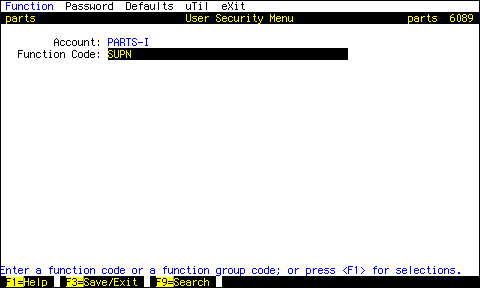
Select SETUP from the menu.   Select fields to update in the same order as your spreadsheet is laid out.   PART-NO. is assumed to be the first field in the file.

If there is an existing setup, F4 clears it, otherwise it returns you to the menu.

F3 saves the setup for this port.   Saving it for the current port means more than 1 user can access SUPN for separate updates.   You should always check the SETUP immediately before doing an update.

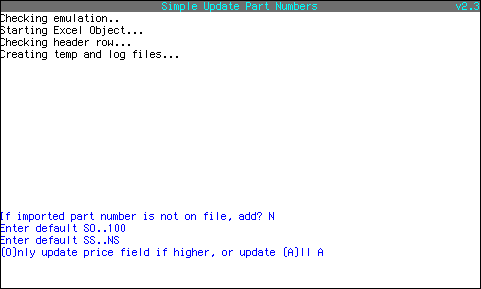
If you did not select SO, you will be prompted for a default.   If you did not select SS, you will be prompted for a default.   If you selected any price fields, you will be given this prompt:
(O)nly update price field if higher, or update (A)ll
Answer O or A depending on what you want the update to do.

If you select ADD/UPDATE PART NUMBERS MANUALLY, you will be prompted for each part #, and then for each field selected in SETUP.   This is best for updating or adding just a few part numbers.

If you selected O.H. in SETUP, and the qty entered is different than the old O.H. (0 for a new number), a plus or minus transaction is recorded.

At the [Paste here now] prompt, paste data copied from your spreadsheet.   This can be done in batches (paste several rows, paste more rows, etc.).   Just press [enter] after the last one.

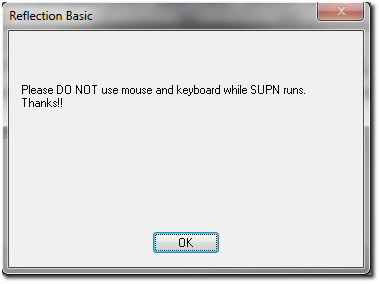
Better yet, there is a Visual Basic Macro for Reflection that can extract the data right out of a saved file and insert it into SUPN.
Please scroll down for instructions on saving a spreadsheet for use by the macro.
Click here to learn how to import a macro into Reflection.

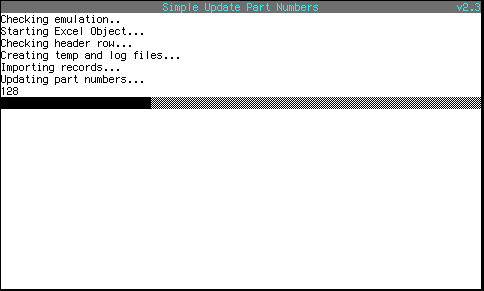
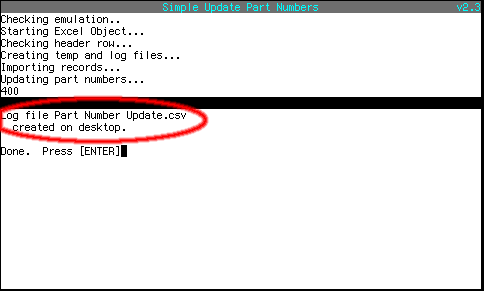
As records are pasted, the only thing echoed on the screen will be the record number in the lower part of the screen.   If the program encounters an error such as a bad source or the wrong number of fields (columns) in a record, it will abort.


Saving a file for use by Visual Basic macro
InputSUPNFile

Create the folder C:\Scheduled if it does not already exist on your computer.
It must be spelled correctly including the upper-case "S" and the rest lower-case.

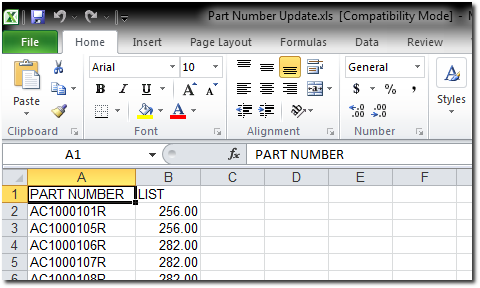
Make sure the data in the spreadsheet is straightforward and clean:
  • Delete the top row if it is a header row.
  • the first column is part numbers
  • there is no extraneous data in columns to the right or rows below
  • all cells within the applicable column/row area have data

Click File | Save As

Navigate to the C:\Scheduled folder.
Save as file name SUPN, and save as type Text (Tab delimited) (*.txt).
There is no need to save again, because you already Saved As.
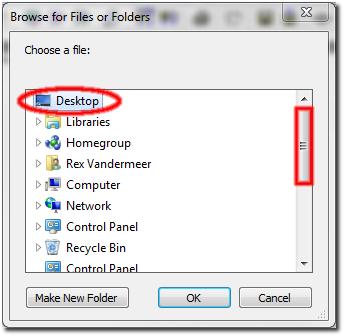
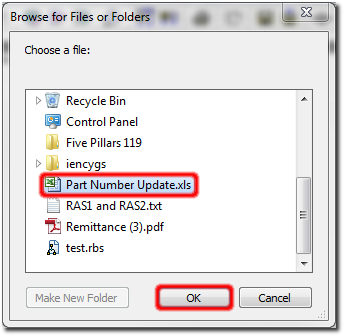
Run the macro at the Paste here now prompt.  See the second screen shot from the top of this page.


Last Updated on ... August 22, 2007